Working paper · RP-2026-01
From Access to Institutions: Tier 4 SACCOs, the MSME Finance Gap, and the Case for Shared Financial Rails in East Africa
East Africa solved financial access faster than it built financial institutions. This working paper assembles the verified evidence across Uganda, Kenya, Rwanda and Tanzania and argues the next frontier of inclusion is shared, regulated, auditable rails for community finance.
- Tier 4 SACCOs
- MSME finance
- Financial inclusion
- Payment infrastructure
Contents
- 1. Abstract
- 2. Introduction
- 3. Literature Review
- 4. Regulatory and Institutional Context
- 5. MSME Finance Gap Analysis
- 6. SACCO Digitization Analysis
- 7. Research Methodology
- 8. Findings
- 9. Discussion
- 10. Strategic Implications
- 11. SenteRail Positioning
- 12. Conclusion
- 13. Future Research Agenda
- Data and Verification Note
- References
- Cite this paper
1. Abstract
Sub-Saharan Africa remains the world’s mobile-money center, yet the financing of micro, small, and medium enterprises (MSMEs) and the modernization of community financial institutions have not kept pace with headline financial access. This paper examines that paradox through the lens of Tier 4 savings and credit cooperative organizations (SACCOs) and community microfinance institutions, anchored in Uganda’s Tier 4 regulatory framework and compared against Kenya, Rwanda, and Tanzania. Using a mixed-methods design — regulatory document analysis, cross-country comparative case study, and secondary quantitative analysis of central bank, supervisory-authority, FinScope, Findex, and GSMA data — the paper tests the thesis that the binding constraint on the next phase of financial inclusion is institutional infrastructure rather than access. The evidence supports five propositions: financial access has expanded faster than institutional capability; SACCOs remain trusted but operationally fragile; MSME credit is constrained more by information asymmetry than by demand; digital credit solved speed but not affordability, transparency, or productive allocation; and shared rails can lower SACCO digitization costs and improve compliance if — and only if — governance is strong. Kenya’s declining MSME loan-account numbers amid record mobile-money penetration, Rwanda’s verified automation of all 416 Umurenge SACCOs and still-evolving consolidation path, Tanzania’s four-tier microfinance structure in which community groups constitute 94.7% of microfinance institutions, and Uganda’s fragmented, transitioning Tier 4 regime together indicate that digitizing individual institutions is necessary but insufficient. The paper contributes a five-model evaluation framework for SACCO digitization and argues that regulated, auditable, interoperable shared rails — treated as public-interest financial infrastructure — are the credible next step for converting community finance institutions into trustworthy gateways for MSME credit, savings, payments, and identity-linked services. A practical infrastructure response under development in Uganda (SenteRail) is assessed against this framework in the final section, with its unresolved risks stated plainly.
2. Introduction
2.1 The paradox
By 2025, mobile money had reached 2.3 billion registered accounts globally and processed US$2.1 trillion in transaction value, according to GSMA’s 2026 State of the Industry Report. The preceding 2025 edition recorded the 2024 milestone that anchors this study period: more than two billion registered accounts globally, with Sub-Saharan Africa holding the majority share. The World Bank’s Global Findex 2025 records Sub-Saharan African account ownership rising from 49% in 2021 to 58% in 2024, with mobile-money use at the highest regional level in the world (World Bank 2025). Kenya reports roughly 90% adult account ownership; Rwanda’s FinScope 2024 reports 96% financial inclusion; Uganda’s FinScope 2023 reports 81%; Tanzania’s FinScope 2023 reports 76% formal inclusion (CBK & FSD Kenya 2024; MINECOFIN/AFR 2024; FSD Uganda 2024; FSDT 2023).
Against this, the institutional picture is starkly different. Kenya’s central bank counted 0.89 million active MSME loan accounts in the entire banking industry at December 2024 — a 24.7% fall from 1.18 million in December 2022 — against a portfolio value of Ksh 784.4 billion that was essentially flat in nominal terms over the same period (CBK 2025a). Uganda’s FinScope 2023 found only 14% of adults banked, with credit-bureau coverage at 6.9% of adults (FSD Uganda 2024). Across the region, the institutions that historically intermediated community savings into local enterprise credit — SACCOs and Tier 4 microfinance institutions — remain predominantly manual, fragmented, and weakly supervised, even where (as in Rwanda) the state has completed a flagship automation programme.
The paradox, then: the region solved access faster than it built institutions. Money moves; institutions that can underwrite, record, supervise, and protect have lagged. This paper asks why, and what kind of infrastructure would close the gap.
2.2 Definitions
- Tier 4 SACCOs and microfinance institutions. In Uganda’s tiered financial-sector structure, Tiers 1–3 (commercial banks, credit institutions, microfinance deposit-taking institutions) are licensed and supervised by the Bank of Uganda; Tier 4 comprises SACCOs, non-deposit-taking microfinance institutions, self-help groups, and community-based microfinance institutions, together with money lenders, regulated under the Tier 4 Microfinance Institutions and Money Lenders Act, 2016. Tanzania’s Microfinance Act, 2018 uses a different tiering in which SACCOs are Tier 3 and community microfinance groups Tier 4 (Section 4.4); this paper uses “Tier 4” in the Ugandan sense unless stated.
- MSMEs. Uganda’s MSME Policy (2015) defines micro enterprises as up to 4 employees with turnover/assets not exceeding UGX 10 million; small as 5–49 employees and assets over UGX 10 million up to UGX 100 million; medium as 50–100 employees and assets up to UGX 360 million. Definitions differ materially across the four countries and across agencies within each country; Section 5.2 treats this as a first-order measurement problem, not a footnote.
- Digital rails. Shared, multi-tenant technical and institutional infrastructure for payments, settlement, ledgers, identity verification, and regulatory reporting, on which multiple institutions transact interoperably — as distinct from institution-by-institution core banking software. The digital public infrastructure (DPI) literature provides the reference cases (D’Silva et al. 2019; Duarte et al. 2022).
- Meaningful financial inclusion. Following the access–usage–financial-health progression in the inclusion literature (Demirgüç-Kunt & Klapper 2013; UNSGSA 2021), we treat inclusion as meaningful when it measurably supports obligation-smoothing, shock absorption, and productive investment — not when an account merely exists.
2.3 Research questions
- RQ1. Why do MSME credit depth and SACCO institutional capability lag headline financial access in East Africa?
- RQ2. How do the four countries’ regulatory architectures for community finance institutions shape digitization pathways and their failure modes?
- RQ3. Which SACCO digitization model — standalone core banking, mobile-money integration, agency banking, cooperative-bank consolidation, or shared rails — best satisfies cost, compliance, auditability, interoperability, trust, resilience, and rural-usability constraints simultaneously?
- RQ4. Under what governance conditions do shared rails convert community finance institutions into trustworthy gateways for MSME finance, rather than new single points of failure or extraction?
2.4 Contribution
The paper makes three contributions. First, it consolidates and quality-grades the empirical record on Tier 4 regulation and SACCO digitization across four jurisdictions whose primary data are scattered across supervisory reports, FinScope surveys, and statutes — with explicit uncertainty labelling where official figures conflict. Second, it proposes a five-model evaluation framework for SACCO digitization strategy (Section 6) and a layered conceptual framework separating access, institutions, and infrastructure (Section 3.9). Third, it derives testable propositions and a future research agenda for what we argue is the region’s next inclusion frontier: institutional infrastructure as a public-interest good.
3. Literature Review
3.1 Financial inclusion theory: access, usage, health
The measurement literature has progressively decomposed “inclusion.” Demirgüç-Kunt and Klapper (2013), analysing the first Global Findex wave, established the canonical distinction between account ownership and account use; Sarma (2008) formalized multidimensional inclusion indices combining penetration, availability, and usage. The 2021 Findex added financial resilience — the ability to raise emergency funds — as a distinct outcome (Demirgüç-Kunt et al. 2022). The financial-health literature (UNSGSA 2021; Ladha et al. 2017) completes the progression: access is an input; usage is behaviour; financial health — meeting obligations, absorbing shocks, pursuing goals — is the outcome of interest. Ozili (2018) cautions that digital finance disproportionately benefits the already-included and that provider incentives, data risk, and voluntary exclusion qualify fintech optimism. This paper’s core claim — that East Africa achieved access without commensurate institutional capability — is an application of this access/usage/health decomposition at the level of institutions rather than individuals: an economy can be “included” at the account layer while remaining excluded at the underwriting, protection, and supervision layers.
3.2 Cooperative finance and the information advantage
The theoretical case for SACCOs is old and strong. Guinnane (2001) shows that German rural credit cooperatives (1883–1914) thrived alongside sophisticated banks because local information and cheap, credible sanctions let them lend to borrowers banks would reject — cooperatives as “information machines.” The ROSCA literature (Besley, Coate & Loury 1993) formalizes why informal group finance improves welfare for those excluded from credit markets, and Dupas and Robinson (2013) demonstrate experimentally that binding savings constraints suppress microenterprise investment even when returns are high. Globally, the cooperative model remains enormous: 412.7 million members in 67,137 credit unions across 101 countries with over US$3.8 trillion in assets at end-2024 — yet only 14% of systems have a credit-union-specific supervisor and 40% lack any deposit guarantee (WOCCU 2025). The literature thus predicts exactly the East African configuration observed in Sections 4–6: institutions with a genuine information advantage, systematically under-supervised and under-equipped.
3.3 MSME credit rationing
Stiglitz and Weiss (1981) establish that under asymmetric information, banks ration credit rather than raise rates, because higher rates worsen the borrower pool and induce risk-shifting. Berger and Udell (1995) show relationship lending substitutes for collateral by generating private information; their later framework (Berger & Udell 2006) decomposes SME lending into discrete technologies — financial-statement lending, asset-based lending, credit scoring, relationship lending — whose feasibility depends on a country’s lending infrastructure: information systems, collateral registries, and legal enforcement. Beck and Demirgüç-Kunt (2006) document that small firms report financing constraints most and benefit most from institutional development. De la Torre, Martínez Pería and Schmukler (2010) complicate the picture: large banks do serve SMEs profitably where arm’s-length technologies are feasible — which sharpens the question of why East African banks retreat from micro and small enterprise lending (Section 5): the missing input is not appetite but underwriting information and enforceable security, i.e., infrastructure.
3.4 Mobile money and digital credit: what the evidence actually shows
Jack and Suri (2014) show M-PESA users fully smooth consumption against shocks that reduce non-users’ consumption by about 7%; Suri and Jack (2016) estimate M-PESA access lifted about 194,000 Kenyan households (2%) out of extreme poverty. These results anchor the access optimism — but they are contested. Bateman, Duvendack and Loubere (2019) challenge the identification and the sustainability of M-PESA-facilitated microenterprises; Aron (2018), reviewing the full empirical literature, finds the risk-sharing results robust but the welfare and macro claims much less so.
The digital-credit evidence is more sobering still. Björkegren and Grissen (2020) show phone-behaviour scoring can rank thin-file borrowers. But CGAP’s two-country survey (Kaffenberger, Totolo & Soursourian 2018) found roughly 50% of Kenyan and 56% of Tanzanian digital borrowers had repaid late, with default at about 12% (Kenya) and about 31% (Tanzania); approximately 2.7 million Kenyans were negatively listed at credit reference bureaus between 2014 and 2016, many for trivial sums (CGAP 2018; Business Today 2019). Kenya’s Competition Authority measured a mean effective APR of 280.5% (median 96.5%) among unregulated digital credit providers (CAK 2021). Experimentally, Bharadwaj, Jack and Suri (2021) find M-Shwari improves shock resilience but is “not a panacea”; Brailovskaya, Dupas and Robinson (2024) find Malawian digital borrowers mostly do not know their loan terms and repay late, incurring heavy fees; Björkegren et al. (2025) find approval of marginal digital-loan applicants in Nigeria raises subjective well-being without detectable income effects. Synthesis: digital credit solved speed and reach; it has not, on current evidence, solved affordability, transparency, or productive allocation — the functions cooperative and relationship lenders theoretically supply.
3.5 Platform infrastructure and digital public infrastructure
The DPI literature supplies the alternative design. D’Silva et al. (2019) analyse India’s identity–payments–data stack as financial infrastructure provided as a public good, compressing decades of bank-led inclusion into years; Duarte et al. (2022) attribute Pix’s enrolment of 67% of Brazilian adults within a year to mandatory participation of large banks and the central bank’s dual role as operator and rule-setter. UPI processed 228.3 billion transactions in calendar 2025 (NPCI 2026); Pix processed 63.4 billion in 2024 (BCB statistics via secondary reporting). In Africa, 36 instant payment systems were live across 31 countries by 2025, processing about 64 billion transactions worth about US$2 trillion in 2024, but with inclusivity and cross-border fragmentation still limiting (AfricaNenda, World Bank & UNECA 2025). He, Huang and Zhou (2023) supply the caution: open, data-sharing infrastructure can intensify competition while leaving all borrowers worse off if extraction dynamics dominate — governance of rails, not just their existence, determines welfare.
3.6 Institutional trust
Afrobarometer Round 9 documents a decade-long decline in institutional trust across Africa (Afrobarometer 2024). Within this low-trust environment, member-owned institutions retain a distinctive social embeddedness: FinScope Uganda 2023 records SACCO savings usage tripling from 5% to 15% of adults between 2018 and 2023 (FSD Uganda 2024), and Kenya’s FinAccess 2024 shows SACCO usage rising from 9.6% to 11.7% even as digital app credit grew fivefold (CBK & FSD Kenya 2024). Trust is the SACCOs’ remaining moat; the governance-failure literature (and the region’s periodic SACCO collapses) shows it is a wasting asset without controls.
3.7 RegTech and SupTech
Broeders and Prenio (2018) and di Castri et al. (2019) document how supervisory technology — automated data collection, API-based reporting, analytics — can extend effective supervision to thousands of small institutions at feasible cost, with the R²A prototyping methodology (di Castri, Grasser & Kulenkampff 2018) demonstrating feasibility in emerging-market authorities. This literature matters here for a structural reason: a Tier 4 sector with tens of thousands of registered institutions (Section 4) cannot be supervised by manual returns. Supervision at that scale is an infrastructure property — regulator-ready data exhaust from shared rails — or it does not happen.
3.8 The gap this paper addresses
Each literature is mature in isolation. What is missing is their intersection: an account of how community finance institutions (3.2), facing information-driven MSME credit rationing (3.3), in economies with mass access but shallow institutions (3.1, 3.4), could be re-platformed on shared, governed infrastructure (3.5, 3.7) without destroying the trust that is their comparative advantage (3.6). East African SACCO scholarship is thin and concentrated in regional journals with limited causal identification (e.g., EAJBE 2026 systematic review; IJRBS 2024 on Tanzanian SACCOs and mobile banking) — itself evidence of the data poverty the paper analyses.
3.9 Conceptual framework (described)
The framework has three horizontal layers and two vertical moderators, best visualized as a layered stack diagram:
- Layer 1 — Access (bottom): mobile money accounts, agents, USSD/smartphone channels. Broad and thin: payments and nano-credit. This layer is largely built (GSMA 2025; World Bank 2025).
- Layer 2 — Institutions (middle): SACCOs, Tier 4 MFIs, community groups, MFBs, banks. These hold member relationships, local information, and underwriting capability. This layer is trusted but fragile: manual records, weak governance, thin supervision.
- Layer 3 — Infrastructure (the missing layer, drawn as a connective lattice between Layers 1 and 2): shared rails for payments/settlement, member/merchant ledgers, identity verification (KYC), audit trails, and regulatory reporting, interoperating institutions with each other, with mobile money, and with banks.
- Vertical moderator A — Governance & supervision (runs down the left edge, touching all layers): proportionate prudential rules, consumer protection, AML/CFT, data protection. Determines whether Layer 3 creates trustworthy intermediation or new extraction.
- Vertical moderator B — Trust & usability (right edge): member trust in institutions, digital literacy, device and connectivity constraints (USSD-first design). Determines whether Layer 3 is adopted at the last mile.
The causal claim of the paper, in the diagram’s terms: MSME financial health (the outcome, drawn above the stack) is produced when Layer 2 institutions are connected through Layer 3 infrastructure under moderators A and B — not by thickening Layer 1 further.
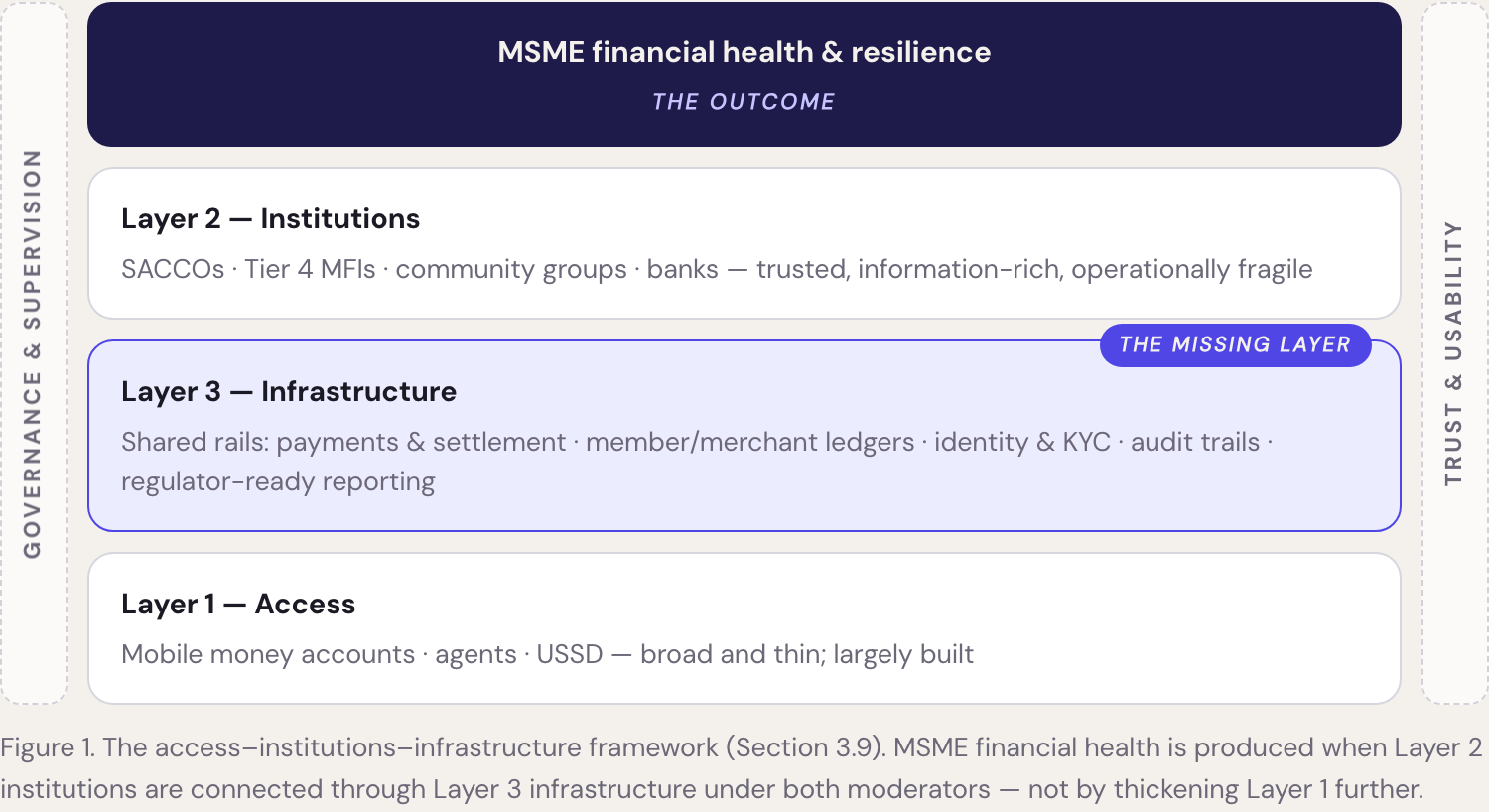
Figure 1. Conceptual framework: access enables movement, shared infrastructure enables interoperability, and institutions convert both into MSME financial health under governance, supervision, trust and usability constraints.
4. Regulatory and Institutional Context
4.1 Uganda: the anchor case
Tier structure. Uganda’s financial sector is organized in four tiers: Tier 1 commercial banks and Tier 2 credit institutions under the Financial Institutions Act 2004 (as amended); Tier 3 microfinance deposit-taking institutions (MDIs) under the Micro Finance Deposit-Taking Institutions Act 2003; and Tier 4 — SACCOs, non-deposit-taking MFIs, self-help groups, and community-based microfinance institutions, plus money lenders — under the Tier 4 Microfinance Institutions and Money Lenders Act, 2016.
The Tier 4 Act. The 2016 Act established the Uganda Microfinance Regulatory Authority (UMRA, s.6), provided for licensing and management of Tier 4 institutions and money lenders, and created a SACCO Stabilization Fund, a SACCO Savings Protection Scheme, and a Central Financing Facility. Subsidiary instruments include the Tier 4 Microfinance and Moneylenders (SACCO) Regulations, 2020, with prudential minima of core capital at 10% of total assets and liquid assets at 15% of savings and short-term liabilities. UMRA licences ran per calendar year, and UMRA published registers of licensed SACCOs, non-deposit-taking MFIs, and money lenders, plus Digital Lending Guidelines (March 2024) requiring digital lenders to hold a licence, maintain a physical address, obtain consent before data sharing, refrain from scraping contact lists for collections, and cap default penalties at 50% of principal. Legal Notice No. 21 of 2024 capped money-lender interest at approximately 2.8% per month.
Institutional flux — three live fault lines. First, UMRA is no longer treated in this paper as a stable standalone regulator: Parliament approved mainstreaming UMRA’s functions into the Ministry of Finance, Planning and Economic Development under the Government’s agency-rationalisation programme, and State House lists the Tier 4 Microfinance Institutions and Money Lenders (Amendment) Bill, 2024 among assented bills. The clean legal question for practitioners is commencement and operational handover, not whether the policy direction exists. Parliament’s Finance Committee observed that UMRA “has not been able to fully execute its mandate” in eight years — an explicit legislative finding of supervisory under-capacity. Second, the large-SACCO boundary is contested: SACCOs with voluntary savings above UGX 1.5 billion and institutional capital above UGX 500 million are directed to Bank of Uganda licensing — currently operationalized through the MDI Act and the MDI (Registered Societies) Regulations 2023, with a Bank of Uganda keynote address stating a 30 September 2026 licensing deadline — while the apex body UCSCU disputes the legal basis. Third, registration and licensing are split: SACCOs register as cooperative societies with the Registrar of Cooperative Societies (Ministry of Trade, Industry and Cooperatives) under the Cooperative Societies Act, while financial-services licensing sat with UMRA — and the Cooperative Societies (Amendment) Act 2020 returned supervisory powers to the Registrar without amending the Tier 4 Act, creating acknowledged overlap.
Scale and the supervision gap. Registered cooperative counts range from 21,346 (2020) to 29,982 (MTIC, June 2021) to 41,621 (2023 reporting, of which about 28,556 are SACCOs). Against this, UMRA records suggest roughly 1,500 licences issued since 2018 with about 900 in operation, and 950 applications processed in FY2023/24 (656 money lenders, 153 NDTMFIs, 151 SACCOs). Whatever the true denominators, the ratio is unambiguous: the overwhelming majority of Uganda’s community finance institutions have never been inside effective prudential supervision.
Adjacent frameworks. The National Payment Systems Act 2020 establishes Bank of Uganda licensing for payment system operators, payment service providers (including e-money issuers), and payment-instrument issuers. The Data Protection and Privacy Act 2019 and its 2021 Regulations, administered by the Personal Data Protection Office, require registration of data collectors and processors. Both apply to any digitization of SACCO operations irrespective of the Tier 4 regime’s institutional form.
4.2 Kenya: supervised depth, shrinking bank MSME books, shared-services turn
Kenya’s SACCO sector is the region’s deepest and best-supervised. Under the Sacco Societies Act (No. 14 of 2008), SASRA supervises 177 deposit-taking SACCOs and 178 non-withdrawable-deposit-taking SACCOs (the latter brought in scope by the Sacco Societies (Non-Deposit-Taking Business) Regulations, 2020 — subsidiary legislation, not an amendment Act — where non-withdrawable deposits exceed Ksh 100 million or membership is mobilized digitally or from the diaspora). In 2024 the regulated sector crossed Ksh 1 trillion in total assets (about 10% year on year), with deposits of Ksh 749.4 billion, gross loans of Ksh 845.1 billion, membership of 7.39 million, and an NPL ratio of 8.39% (SASRA 2025). Institutionally, Kenya is now executing the shared-services turn this paper’s thesis predicts: Sacco Central Kenya is being operationalized as a central institution for shared digital services, inter-SACCO payments, direct SACCO participation in the national payment system, and inter-SACCO liquidity, with Cabinet approving the SACCO Societies (Amendment) Bill, 2023 in March 2025 to introduce a shared-services framework (FSD Kenya 2024; National Treasury 2025). Digital credit was brought inside the perimeter by the CBK (Digital Credit Providers) Regulations 2022; 227 DCPs were licensed by April 2026 from over 800 applications, with licensed DCPs reporting 7.5 million loans worth Ksh 133.5 billion by February 2026.
4.3 Rwanda: the state-led consolidation model
Rwanda represents the opposite pole from Uganda’s fragmentation: a single, state-driven programme. Following the 2008 National Dialogue, 416 Umurenge SACCOs were created — one per administrative sector — explicitly to close the 52% exclusion measured by FinScope 2008. In June 2024, MINECOFIN announced that automation of all 416 Umurenge SACCOs was complete, on a shared core banking system, as phase one of a three-step programme: automation, consolidation into district SACCOs, then a cooperative bank. Official budget documents and MINECOFIN reporting confirm the intended 416-to-30 consolidation path, but this public version treats the consolidation and cooperative-bank phases as in transition unless supported by a current official operational notice. FinScope Rwanda 2024 records 96% financial inclusion, up from 93% in 2020. Prudential supervision of SACCOs/MFIs sits with the National Bank of Rwanda, with the Rwanda Cooperative Agency handling cooperative registration.
4.4 Tanzania: the four-tier codification of informality
Tanzania’s Microfinance Act, 2018 classifies microfinance into: Tier 1 deposit-taking MFIs; Tier 2 non-deposit-taking providers; Tier 3 SACCOs; and Tier 4 community microfinance groups, including individual money lenders and community-based organizations — with Tiers 1–3 licensed under Bank of Tanzania oversight (SACCO licensing administered via the Tanzania Cooperative Development Commission) and Tier 4 groups registered through local authorities. The composition is the striking fact: Tanzania’s Annual Financial Inclusion Report 2024 records Tier 4 community microfinance groups as 94.7% of all microfinance institutions, within a population of some 62,232 licensed/registered microfinance service providers at end-2024. TCDC’s 2023 performance report records 884 SACCOs with 1.82 million members, TZS 966.9 billion in savings, TZS 1.113 trillion in loans and TZS 1.328 trillion in assets — but the registered-versus-licensed basis of the 884 count is unclear against earlier counts of 2,034 (2022) and 6,178 (2019). FinScope Tanzania 2023 records formal inclusion at 76% (from 65% in 2017), mobile-money uptake at 72%, mobile-phone ownership at 75% — while a widely circulated claim that smartphone ownership is “below 20%” could not be verified against the survey (the nearest verified figure, TCRA’s about 32% smartphone share of subscriptions, measures a different denominator). On rails, Tanzania pioneered operator-led bilateral wallet interoperability (2014–2016, the first full P2P interoperability market in Africa) and now operates TIPS, the Bank of Tanzania’s Mojaloop-based instant payment switch (piloted 2021; about 45 providers connected by early 2025; 453.7 million transactions worth TZS 29.9 trillion reported for 2024).
4.5 Comparative synthesis
Table 1. Regulatory and institutional comparison (as at mid-2026)
| Dimension | Uganda | Kenya | Rwanda | Tanzania |
|---|---|---|---|---|
| Community-finance regulator | UMRA/Tier 4 department transition under MoFPED; BoU for “large” SACCOs (contested) | SASRA (Sacco Societies Act 2008 + 2020 NDT Regulations) | BNR (prudential) + RCA (cooperative registration) | BoT (Tiers 1–2), TCDC under BoT oversight (Tier 3 SACCOs), local authorities (Tier 4 CMGs) |
| Institutions in scope (approx.) | About 29,982 registered cooperatives (MTIC 2021); about 900 UMRA-licensed in operation | 355–357 regulated SACCOs (177 DT); 7.39m members | 416 U-SACCOs fully automated; 30 D-SACCO consolidation path underway; cooperative bank pending | 884 licensed SACCOs (2023, basis unclear); Tier 4 CMGs = 94.7% of MFIs |
| Supervision coverage | Very low (licensed far below registered) | High for regulated perimeter | High (single programme) | Split: formal tiers supervised; CMG mass registered only |
| Digitization model in force | Fragmented, vendor-by-vendor | Institution-led + emerging shared services (Sacco Central) | State-led shared core banking + consolidation | Codified informality + national instant switch (TIPS) |
| Deposit protection for members | SACCO Savings Protection Scheme in statute; operational status unverified | DT-SACCO framework under SASRA; no full DGS for all SACCOs | Under BNR framework | None for Tier 4 CMGs |
| Digital lending regime | UMRA Digital Lending Guidelines (2024); Legal Notice 21/2024 interest cap | CBK DCP Regulations 2022; 227 licensed (Apr 2026) | Not separately assessed | Microfinance Act tiers apply |
| National interoperable retail switch | Announced/procured, not live (reported stalled) | Announced FPS (Oct 2024), in development; wallet & merchant interop live | eKash/RNDPS (reported Mojaloop-linked) | TIPS live (Mojaloop-based) |
| Data protection | DPPA 2019 + PDPO | DPA 2019 + ODPC | Law No. 058/2021 | PDPA 2022 |
Why Uganda’s Tier 4 framework matters. Uganda is the limiting case that motivates the infrastructure thesis. It has (i) the largest gap between registered institutions and supervised institutions; (ii) a legislature-documented finding that its dedicated Tier 4 regulator could not execute its mandate with available resources; (iii) an unresolved, litigious boundary between cooperative and prudential supervision; and (iv) no live national retail switch. Every failure mode the conceptual framework predicts when Layer 3 is absent — unsupervisable scale, ungoverned digitization, weak member protection — is observable in Uganda simultaneously. Conversely, precisely because supervision capacity is the binding constraint, Uganda is where regulator-ready shared rails would have the highest marginal supervisory value: the Tier 4 population cannot be supervised by adding inspectors; it can only be supervised through data infrastructure (Section 3.7).
5. MSME Finance Gap Analysis
5.1 The Kenyan evidence: retreat under full information visibility
Kenya is the strongest test case because its data are best. The CBK’s 2024 Survey Report on MSME Access to Bank Credit records 0.89 million active MSME loan accounts at December 2024 — down 24.7% from 1.18 million at December 2022 — with the outstanding portfolio essentially flat at Ksh 784.4 billion (vs Ksh 783.3 billion), i.e., a substantial real-terms contraction (CBK 2025a). Loan application and approval flows fell 13.1% against the 2022 survey. Banks and microfinance banks wrote off Ksh 8.8 billion of MSME loans across more than 95,000 accounts in 2024 — the affected account count rising nearly fivefold year-on-year — while recovery costs rose about 15–16%. Average interest charged to MSMEs stood at 16.4% (banks) and 26.3% (MFBs). On collateral, a widely circulated range of 93%–112% of loan value attributed to the 2024 survey could not be verified against the published survey materials; the nearest verified figure is micro-lenders requiring collateral of 83.06%–91.38% of loan value from an earlier CBK MSME survey. Either range makes the same analytical point: collateral requirements approaching or exceeding the loan amount are not risk mitigation; they are a substitute for information. A lender demanding about 100% security has priced its own underwriting knowledge at approximately zero — Stiglitz–Weiss rationing made visible on a balance sheet.
The composition of the contraction matters as much as its size. Over the same 2022–2024 window in which bank MSME accounts fell by a quarter, FinAccess 2024 records digital MFI/app credit usage rising from 1.7% to 8.8% of adults, Hustler Fund uptake surging, and SACCO usage rising from 9.6% to 11.7% (CBK & FSD Kenya 2024). Licensed digital credit providers alone reported 7.5 million loans by February 2026 — nearly an order of magnitude more accounts than the entire banking industry’s MSME book, at a small fraction of its value. Credit is migrating from few-large-underwritten facilities to many-small-automated ones. Whether that migration finances working capital and investment, or merely liquidity and consumption smoothing at high effective cost (CAK 2021; Section 3.4), is precisely the affordability-and-allocation question the digital-credit literature answers pessimistically.
5.2 Uganda: measurement as a first-order constraint
Uganda’s MSME statistics illustrate why “reconcile definitions first” is a methodological requirement, not pedantry:
- Policy and ministerial statements cite about 1.1 million MSMEs, “90% of the private sector,” employment of about 2.5 million (or “more than 3 million” in the 2024 State of Entrepreneurship report), and GDP contributions variously stated between 18% and 80%.
- The census record is smaller and better defined: UBOS’s Census of Business Establishments counted 458,106 establishments in 2010/11 and 686,700 in 2019/20 (+49.9%), of which 81.7% informal, 49% single-person, 84.8% sole proprietorships, employing 2.7 million in total.
- The gap between 1.1 million and about 687,000 is definitional: COBE counts establishments with fixed premises; the policy figure sweeps in household and mobile enterprises. Both are “true”; neither substitutes for the other.
- Demand-side: IFC’s 2021 survey-based estimate put Ugandan MSME credit demand at about UGX 31.4 trillion (US$8.8 billion) (IFC 2021); FinScope 2023 puts banked adults at 14% and credit-bureau coverage at 6.9% of adults (FSD Uganda 2024).
The methodological implication generalizes to all four countries: MSME finance-gap figures inherit the noise of their enterprise denominators. This paper therefore treats gap magnitudes as ordinal (large, persistent) rather than cardinal, and flags every headline figure to its definitional basis.
5.3 The anatomy of the gap
Synthesizing Sections 5.1–5.2 with the literature (Sections 3.3–3.4), the gap decomposes into six mutually reinforcing constraints:
Table 2. MSME finance constraints and their institutional counterparts
| Constraint | Evidence (this paper) | Why banks retreat | Why SACCOs/Tier 4 remain relevant |
|---|---|---|---|
| Information asymmetry / thin files | 6.9% credit-bureau coverage (UG); collateral about equal to loan value (KE) | Arm’s-length technologies infeasible without data infrastructure (Berger & Udell 2006) | Local information and social enforcement (Guinnane 2001) |
| Collateral dependence | 83–91% verified (KE, micro-lenders); 93–112% asserted | Fixed-cost underwriting greater than margin on small tickets | Share-and-savings-secured lending; character lending |
| Informality & weak records | 81.7% of UG establishments informal (COBE 2019/20); 61% unregistered (SoE 2024) | Unauditable cash flows fail statement-lending | Member transaction history substitutes for statements — if recorded |
| NPL and macro pressure | Ksh 8.8bn MSME write-offs, affected accounts rose fivefold (KE 2024); Hustler Fund default contested at 15%–68% | Risk-off rationing (Stiglitz–Weiss 1981) | Member equity buffers; but SACCO NPLs rise too (8.39%, SASRA 2024) |
| Gender/youth/rural divides | Sub-Saharan Africa account gender gap about 12 percentage points (Findex); women 55% of unbanked | Distribution cost of last mile | SACCO/CMG density in rural areas (94.7% of TZ MFIs are community groups) |
| Cash-flow mismatch | Digital credit: 30-day nano-loans vs MSME working-capital cycles; about 50% late repayment (CGAP 2018) | Product design mismatch | Cooperative products can match agricultural/trade cycles — with liquidity discipline |
Two conclusions follow. First, the gap is informational before it is financial: every constraint in Table 2 except macro pressure is at root a data problem — invisible cash flows, unrecorded repayment histories, unverifiable identity, unauditable ledgers. Second, the institutions best placed to originate that missing information are the ones closest to the borrower — SACCOs and community institutions — but they can only convert local knowledge into bankable information capital if their records are digital, standardized, auditable, and portable. That is a rails property, not a software property, and it motivates Section 6.
6. SACCO Digitization Analysis
6.1 Five models
Observed digitization strategies in the region reduce to five models:
(a) Standalone core banking. Each SACCO procures its own management information system (commercial or bespoke). This is the default in Uganda and Tanzania; the Tanzanian computerization literature finds most SACCOs still manual, with failed or partial adoptions common (AJSTID 2026; Mercy Corps & Ensibuuko 2019 for Uganda’s practitioner evidence). Costs are duplicated across thousands of institutions; vendor quality is unsupervised; data schemas are incompatible, so supervision still runs on manual returns.
(b) Mobile-money integration. The SACCO connects (usually via an aggregator) to MTN/Airtel/M-PESA wallets for deposits, repayments, and disbursements. This meets members where they transact — 64–86% mobile-money usage across the four countries — but integration quality varies, reconciliation between wallet statements and SACCO ledgers is typically manual, and fees accumulate per hop.
(c) Agency banking. SACCOs or their members ride bank agent networks (Kenya: 82,780 bank agents in 2021 and 381,116 mobile-money agents by end-2024; Uganda: a shared agent-banking platform launched April 2018 under the Uganda Bankers’ Association’s Agent Banking Company, following the Financial Institutions (Amendment) Act 2016 and 2017 Agent Banking Regulations, reaching more than 20,000 agents across 22 of 25 banks by 2022). Agency extends cash-in/cash-out reach but does not digitize the SACCO’s own books or make it interoperable.
(d) Cooperative-bank consolidation. Rwanda’s model: automate all institutions onto one shared core system, move 416 sector SACCOs toward 30 district SACCOs, then aggregate into a cooperative bank (Section 4.3). This aims to achieve uniformity, supervision, and scale by merging institutions — at the price of local autonomy, and feasible only with strong state capacity and a single-programme mandate.
(e) Shared payment/identity/ledger rails. Institutions remain independent but transact on common multi-tenant infrastructure: shared member/merchant ledgers, payment and settlement rails interoperable with wallets and banks, shared KYC/identity verification, and standardized regulator-ready reporting. Kenya’s Sacco Central and shared-services framework is the region’s most explicit institutional move in this direction (Section 4.2); Tanzania’s TIPS and the DPI precedents (UPI, Pix, Mojaloop deployments) supply the payments layer of the pattern (Section 3.5).
6.2 Evaluation
Table 3. Digitization models evaluated (H = high / strong, M = medium, L = low / weak)
| Criterion | (a) Standalone core | (b) Mobile-money integration | (c) Agency banking | (d) Coop-bank consolidation | (e) Shared rails |
|---|---|---|---|---|---|
| Cost to a small Tier 4 SACCO | L (capex + licence + IT staff duplicated) | M (aggregator fees per txn) | M | H fixed programme cost, L per-SACCO | M to H at start-up, L at scale (cost mutualized) |
| Compliance & supervision fit | L (heterogeneous, unauditable schemas) | L–M | L (extends cash, not controls) | H (single supervised platform) | H (uniform data, regulator-ready reporting) — if mandated standards |
| Auditability | L–M (vendor-dependent) | L (manual reconciliation) | L | H | H (immutable shared ledgers, audit trails by design) |
| Interoperability | L | M (one-way, per-wallet) | M | M (internal only) | H (by construction) |
| Member/user trust | M (institution keeps its face) | M–H (familiar channels) | M | M (identity loss risk in mergers) | H if institution-fronted; L if platform disintermediates the SACCO |
| Resilience / continuity | L (single-institution IT) | M | M | M–H (concentration risk) | M–H (professional ops; but platform = single point of failure — Section 9) |
| Rural usability (USSD, low-smartphone) | Vendor-dependent | H | H (human agents) | M–H (Rwanda: USSD-first D-SACCO channel, reported rollout) | H if USSD/agent-first is a design requirement |
| Sovereignty / autonomy of the SACCO | H | H | H | L | M–H (autonomy retained; dependency created) |
Three readings of Table 3. First, models are complements, not substitutes: Rwanda’s consolidation runs on a shared core system; Kenya’s shared services presuppose digitized SACCOs; mobile-money integration is a feature of rails, not an alternative to them. Second, the models divide on where the integration burden falls: (a)–(c) leave it with each SACCO (which is why they stall at reconciliation and reporting); (d)–(e) mutualize it. Third, (d) and (e) differ on the political economy: consolidation buys uniformity with institutional identity, feasible under Rwanda’s state capacity; shared rails buy uniformity with a governance problem — who owns the platform, who sets fees, who sees the data — which is exactly the He–Huang–Zhou (2023) extraction risk and the reason Mowali, the Orange–MTN pan-African Mojaloop venture, wound down in 2022 without central-bank approvals. The rails model’s binding constraint is governance, not technology. Section 9 and Section 11 return to this.
7. Research Methodology
7.1 Design
The paper employs a sequential mixed-methods design with four components:
- Policy and regulatory document analysis. Statutes, subsidiary instruments, and supervisory guidance for the four countries (Tier 4 Act 2016 and 2024 Amendment, SACCO Regulations 2020, NPS Act 2020, DPPA 2019; Sacco Societies Act 2008 and NDT Regulations 2020, DCP Regulations 2022; Rwanda’s Microfinance Law and Regulation 57/2023; Tanzania’s Microfinance Act 2018 and SACCOS Regulations 2019), coded for perimeter, prudential limits, deposit-taking boundaries, governance, AML/CFT, consumer protection, complaints, data protection, and digital-lending rules.
- Cross-country comparative case study. Uganda as anchor (fragmented regime in transition), Kenya (supervised depth + shared-services turn), Rwanda (state-led consolidation), Tanzania (codified informality + national switch) — selected as most-different cases on the digitization-model dimension while sharing the mobile-money-first access profile.
- Secondary quantitative analysis. CBK MSME surveys and FinAccess (Kenya), SASRA supervision reports, UMRA registers and MoFPED budget documents (Uganda), BoT/NCFI financial-inclusion and supervision reports and TCDC performance reports (Tanzania), BNR/MINECOFIN and FinScope (Rwanda), World Bank Findex 2021/2025, GSMA SOTIR 2024–2026, IFC MSME finance-gap estimates, and WOCCU statistics.
- Expert interviews (proposed instrument). Semi-structured interviews with SACCO managers and board members, Tier 4 supervisors, fintech operators, MSME owners, and mobile-money agents in Uganda and Kenya (target sample size: 40–60), sampled purposively across licensed/unlicensed and rural/urban strata, coded thematically against the Section 3.9 framework. Optional field survey: a structured survey of Tier 4 SACCOs (record-keeping practice, system cost, reconciliation effort, reporting burden) and their MSME members (credit access, collateral, transaction-history awareness), Uganda, stratified by region and size.
Components 1–3 are executed in this draft; component 4 is specified for the next phase and its absence is a stated limitation.
7.2 Propositions
- P1. Financial access has expanded faster than institutional capability (access–institution divergence).
- P2. SACCOs remain trusted but operationally fragile (trust–fragility coexistence).
- P3. MSME credit is constrained by information asymmetry more than by demand deficit.
- P4. Digital credit solved speed but not affordability, transparency, or productive lending.
- P5. Shared rails lower SACCO digitization cost and improve compliance conditional on strong governance.
P1–P4 are assessed against the assembled evidence (Section 8); P5 is partially assessable (design and early institutional evidence) and framed as the hypothesis for the future research agenda (Section 13).
7.3 Data-quality caveats
(i) Definitional heterogeneity. MSME definitions differ by employees, assets, and turnover across and within countries (Section 5.2); SACCO counts differ by registered, licensed, or active basis (Uganda about 30,000 registered versus about 900 licensed-in-operation; Tanzania 884 versus 2,034 versus 6,178). All cross-country magnitudes are treated as ordinal. (ii) Survey non-comparability. FinScope, FinAccess, and Findex differ in sampling frames, inclusion definitions, and fieldwork years; levels are not directly comparable across instruments, only within-instrument trends. (iii) Contested official figures. Hustler Fund default rates span 15% (fund management, March 2026) to 68.3% (Auditor-General-linked reporting); both are reported with dates rather than adjudicated. (iv) Regulatory flux. Uganda’s Tier 4 institutional arrangements changed materially during the study window (UMRA mainstreaming; large-SACCO licensing dispute); statements are time-stamped as at 14 July 2026.
7.4 Verification discipline
Every material figure in this paper carries a stated provenance: verified against the primary publisher’s own document or page (with access date), traced to reputable secondary reporting of a primary document, or explicitly marked unverifiable and excluded from findings. Two widely circulated figures failed that test and are excluded (see the Data and Verification Note). No figure is asserted beyond its provenance.
8. Findings
8.1 P1 — Access has outrun institutional capability: supported
Across all four countries, account-layer metrics are at or near saturation (Kenya about 90% ownership and mobile-money subscriptions about equal to 100% of population by Q1 2026; Rwanda 96% inclusion; Uganda 81%; Tanzania 76–81%), while institution-layer metrics stagnate or contract: Kenya’s bank MSME accounts fell 24.7% between 2022 and 2024; Uganda’s banked share is 14% with 6.9% bureau coverage; Tanzania’s SACCO membership is 1.82 million against 72% mobile-money uptake; Uganda’s supervised Tier 4 population is a small fraction of registered institutions. The legislative record makes the capability gap explicit: Uganda moved to mainstream UMRA after a parliamentary record of supervisory under-capacity. Access grew where marginal cost per user was near zero (Layer 1); capability did not grow where it requires per-institution investment in records, governance, and supervision (Layer 2). This is the divergence the conceptual framework predicts when Layer 3 is missing.
8.2 P2 — Trusted but fragile: supported
Demand-side surveys show SACCO usage rising through the digital-credit boom — Uganda from 5% to 14% of adults using SACCOs between 2018 and 2023, with SACCOs recording the highest service-provider uptake increase in the FinScope summary; Kenya from 9.6% to 11.7% (2021–2024); and Rwanda’s U-SACCO network embedded in the national inclusion strategy — against a backdrop of declining generalized institutional trust (Afrobarometer 2024). Supply-side, fragility is documented rather than anecdotal: most Tanzanian SACCOs remain manual with governance failures linked to record-keeping (AJSTID 2026); Uganda’s supervised share is minimal and its stabilization/protection schemes’ operational status unverified; Kenya’s regulated SACCOs carry an 8.39% NPL ratio with rising risk flagged by the supervisor; Rwanda required a long state programme to automate ledgers whose weaknesses were the programme’s stated rationale. Trust is an inherited stock; the operational capability to protect it is not yet built.
8.3 P3 — Information asymmetry binds more than demand: supported
Direct evidence: collateral at or near 100% of loan value (Section 5.1) prices bank underwriting information at zero; approval rates in Kenya remain high (88.4% of applied value) while application volumes fall — rationing operates through discouragement and security requirements, not marginal rejections; IFC-measured Ugandan credit demand (US$8.8 billion) coexists with 6.9% bureau coverage. Counterfactual evidence: where alternative data exists, credit extends — phone-behaviour scoring ranks thin-file borrowers (Björkegren & Grissen 2020), and licensed Kenyan DCPs originated 7.5 million loans on telco data. The demand is intermediable; the information is missing at the institutions that could intermediate it productively.
8.4 P4 — Digital credit: speed without affordability, transparency, or allocation: supported
Scale is undisputed (Fuliza disbursements of Ksh 1.47 trillion in FY2026; 32% of Kenyan adults borrowing from mobile-money providers per Findex 2025). So are the pathologies: mean effective APR of 280.5% among unregulated providers (CAK 2021); about 50% late repayment in Kenya and 56% in Tanzania, and default of 12% in Kenya and 31% in Tanzania (CGAP 2018); 2.7 million negative listings; borrowers who do not know their loan terms (Brailovskaya et al. 2024); resilience benefits without income effects (Bharadwaj et al. 2021; Björkegren et al. 2025); and a state-run corrective (Hustler Fund) whose default performance is contested between 15% and 68%. Regulatory response (Kenya’s DCP Regulations; Uganda’s 2024 Digital Lending Guidelines and interest cap) confirms the diagnosis. Digital credit demonstrated that rails can move risk decisions in seconds; it did not supply the institutional underwriting, product fit, or recourse that MSME finance requires.
8.5 P5 — Shared rails lower cost and improve compliance, conditional on governance: provisionally supported; the governance condition is binding
Positive evidence: Rwanda’s shared-core programme took an unsupervisable network of 416 manual SACCOs to full automation and a consolidation path — outcomes unreachable institution-by-institution. Kenya’s supervisor-adjacent shared-services framework (Sacco Central; Amendment Bill 2023) is an explicit regulatory bet on mutualized infrastructure. Tanzania’s TIPS and the DPI precedents (UPI, Pix, 36 live African IPS) demonstrate the cost and inclusion economics of shared switches. Negative evidence defining the condition: Mowali’s wind-down (approval/governance failure, not technology); Uganda’s still-uncompleted national switch ambition; He–Huang–Zhou’s demonstration that data-sharing infrastructure can immiserate borrowers under extractive governance; and the open-finance risks catalogued in Section 9. The proposition survives as a conditional: rails deliver if participation rules, fee governance, data rights, and supervisory integration are set correctly — which is a design brief, not a foregone conclusion.
9. Discussion
9.1 “Digitizing the SACCO” versus “making the SACCO interoperable”
The region’s decade of SACCO digitization projects has mostly meant replacing paper ledgers with a database — model (a) of Section 6. The findings show why this under-delivers: a digitized but isolated SACCO still reconciles wallet statements by hand, still files supervisory returns manually (or not at all), still cannot verify identity against national systems, still cannot settle with banks except through a branch queue, and still produces member data in a schema no credit bureau, bank partner, or supervisor can consume. Digitization changes the medium of the institution’s records; interoperability changes their economic character — from private notes into information capital: portable transaction histories that function as collateral substitutes (Section 5.3), auditable trails that function as supervision inputs (Section 3.7), and settlement connectivity that functions as liquidity access. The policy-relevant distinction is therefore not digital/manual but isolated/interoperable. Rwanda understood this and built the shared layer by state fiat; Kenya is building it by supervised mutualization; Uganda and Tanzania’s Tier 4 mass remains largely isolated whichever medium its records are in.
9.2 Risks of the rails model
An interoperable-rails agenda imports its own failure modes, each with regional precedent:
Table 4. Risk register for shared community-finance rails
| Risk | Mechanism | Regional evidence / precedent | Primary mitigations |
|---|---|---|---|
| Cyber risk | Concentration: one platform, thousands of institutions, one attack surface | Rising fraud on mobile rails region-wide | Security-by-design, independent audits, incident-response obligations, supervisory cyber standards |
| Data misuse | Platform sees all member/MSME data; monetization or leakage | Contact-list scraping by digital lenders (prohibited by UMRA 2024 Guidelines); CRB mass-listing harms | Data-protection registration, purpose limitation, consent capture, controller/processor clarity, PII redaction |
| Platform dependency | SACCOs lose exit options; fee ratchets; vendor capture | Aggregator lock-in in model (b); Mowali’s single-JV failure | Open standards, data portability, exit clauses, fee governance with participant representation |
| Exclusion of non-smartphone users | App-first design excludes feature-phone majority segments | Tanzania smartphone share of subscriptions about 32%; USSD still dominant rural channel | USSD/agent-first design mandate (Rwanda’s D-SACCO USSD rollout as template) |
| Regulatory arbitrage | Unlicensed platform performs regulated functions (payments, deposit-like floats) | Uganda’s unlicensed digital-lender app wave (2024 government blacklist) | Explicit licensing posture; conservative default that regulated functions require the licence (Section 11) |
| Weak recourse | Complaints fall between SACCO, platform, wallet, and bank | Digital-credit borrowers without effective complaint channels (CGAP 2018) | Statutory complaints handling, defined liability allocation, ombuds integration |
| Over-indebtedness | Faster origination without shared exposure visibility | Multi-app stacking in Kenya pre-2022 | Shared exposure reporting, affordability checks, bureau integration at the rails layer |
| Governance capture / extraction | Fee and data rules set by the platform against members’ interests | He, Huang & Zhou (2023); open-banking extraction dynamics | Multi-stakeholder governance, supervisory oversight of scheme rules, cooperative ownership options |
9.3 What the rails must therefore provide
The risk register converts directly into a requirements set. Rails fit for community finance must support: USSD and assisted (agent/branch) access as first-class channels; immutable audit trails on every money movement and record change; identity verification integrated with national ID systems under data-protection law; wallet–bank–SACCO interoperability for deposits, repayments, disbursements, and settlement; member and merchant ledgers with standardized, exportable schemas; complaints and dispute workflows with defined liability; and regulator-ready reporting generated from the transaction layer rather than reconstructed after the fact. Each requirement is the direct negation of a documented failure mode, not a feature wishlist.
10. Strategic Implications
For regulators. (i) Proportionate, tiered supervision that matches obligation to risk — Tanzania’s four-tier codification and Kenya’s Ksh 100 million NDT threshold are workable templates; Uganda’s post-UMRA department should preserve tiering while fixing the registrar/licensor split. (ii) Open, mandated data standards for SACCO reporting, so that whichever systems institutions use, supervision consumes one schema — the suptech literature (Section 3.7) shows supervision at Tier 4 scale is only feasible as data infrastructure. (iii) Treat national switches and shared SACCO platforms as regulated financial market infrastructure with governance requirements (participation, fees, data rights), learning from Pix’s mandatory-participation design and Mowali’s approval failure. (iv) Extend digital-lending conduct rules (consent, pricing disclosure, collections limits, complaints) across the Tier 4 perimeter, as Uganda’s 2024 Guidelines began to do.
For SACCOs. Governance is the license to digitize: boards that cannot supervise a manual ledger cannot supervise a platform contract. Priorities: member-data quality (the asset that becomes information capital), liquidity discipline ahead of any settlement connectivity, basic cyber hygiene and access control, and collective negotiation — through apexes or shared-services vehicles — rather than SACCO-by-SACCO vendor contracts.
For banks. The evidence (Section 5) shows banks retreating from direct micro/small lending while holding the settlement, treasury, and prudential infrastructure SACCOs lack. The complementary strategy is partnership: SACCOs as trusted origination and savings channels riding bank settlement and liquidity — formalized in Uganda by the BoU direction that regulated providers transact with licensed large SACCOs — rather than competition for the same thin files.
For MSMEs. Transaction histories are information capital. An MSME that routes its turnover through recorded channels — SACCO account, wallet, interoperable merchant rails — is building the file that substitutes for the collateral it does not have. Policy and product design should make that accumulation automatic and portable (with consent), not an act of financial sophistication.
For fintechs. The digital-credit decade demonstrates the ceiling of isolated lending apps: speed without institutions produced 280% APRs, mass blacklisting, and regulatory backlash. The durable opportunity is infrastructure-first: supplying the ledgers, rails, compliance tooling, and reporting that make existing trusted institutions capable — capturing value from the system’s functioning rather than from its information asymmetries.
11. SenteRail Positioning
This section applies the paper’s framework to one practical infrastructure response now under development in Uganda. It is deliberately placed last and written in conditional language; nothing here is a performance claim.
11.1 What SenteRail is
SenteRail Technologies Company Limited is a Ugandan technology company (incorporated 31 May 2026, URSB Reg. No. 80034644601118) building financial rails for SACCOs, small businesses, fintechs, and their members. Its documented design centres on: SACCO member onboarding and account primitives with KYC evidence capture and consent records; an authoritative double-entry ledger with an auditable projection layer; payment orchestration across Uganda’s mobile-money rails (MTN MoMo, Airtel Money) with reconciliation and settlement reporting; merchant/MSME transaction records under a unified reference model; immutable audit trails; and regulator-ready reporting exports. Its stated operating posture is pre-licence technology provider: SenteRail holds no Uganda financial-sector licence; in lending workflows the SACCO is the lender of record; SenteRail is not a lender, bank, or licensed/regulated entity, and its regulated-market entry path runs through the Bank of Uganda sandbox and, where required, PSP/PSO licensing under the National Payment Systems Act 2020.
11.2 Mapping to the identified gaps
Table 5. SenteRail positioning against identified gaps
| Gap identified in this paper | SenteRail’s positioned response | Status language |
|---|---|---|
| Isolated SACCO records; manual reconciliation (Section 6, Section 9.1) | Shared member/merchant ledger with wallet-integrated payment orchestration and automated reconciliation | is positioned to address, if executed |
| Thin MSME files (Section 5.3) | Merchant/MSME transaction records under one reference model, portable with consent | could create information capital |
| Unsupervisable Tier 4 scale (Section 4.1, Section 3.7) | Regulator-ready reporting generated from the transaction layer; immutable audit chain | could reduce supervisory cost |
| KYC/identity gaps (Section 9.3) | Member onboarding with documented KYC evidence, consent capture, and audit events | is designed to support |
| Last-mile usability (Section 9.2) | Branch-assisted and invite-led onboarding; USSD support on the roadmap | partially addresses; USSD delivery is unproven |
| Weak recourse (Section 9.2) | Complaints and dispute workflows with defined states | requires operational proof |
| Interoperability (Section 9.1) | Orchestration across MTN/Airtel today; bank settlement and any future national switch integration | depends on partnerships and BoU switch timeline |
11.3 What SenteRail must solve — stated plainly
The paper’s own risk register (Table 4) applies to SenteRail without discount. Specifically: licensing posture — whether its payment orchestration and settlement activities require NPS Act licensing must be resolved with the regulator before production money movement; the conservative default adopted here is that they do. Bank partnerships — settlement without a banking partner is not credible; none is evidenced in this public paper. Uptime and operational resilience — a rails provider inherits the concentration risk of Section 9.2 and must evidence availability, disaster recovery, and incident response before institutions depend on it. Cybersecurity — multi-tenant SACCO data is a high-value target; independent security assurance is a precondition of trust, not a post-launch enhancement. Complaints handling — liability allocation across SACCO/platform/wallet must be contractual and member-visible. Pricing — last-mile affordability discipline: rails that reprice like digital credit did would reproduce the Section 8.4 pathology. Data protection — PDPO registration and controller/processor clarity with each SACCO must be verified before launch claims. Trust-building with SACCO leadership — the trust asset (Section 8.2) belongs to the SACCOs; an infrastructure provider earns adoption by keeping the SACCO as the member-facing institution and proving governance, not by disintermediating it.
If executed with strong governance, SenteRail is an instance of the paper’s thesis — infrastructure that makes trusted community institutions capable, rather than another app competing for thin files. Whether it becomes a successful instance is an empirical question this paper cannot and does not answer.
12. Conclusion
East Africa’s first financial-inclusion problem — access — has largely been solved by mobile money: 2.3 billion mobile-money accounts globally by 2025, the world’s highest mobile-money usage levels in Sub-Saharan Africa, and near-saturation penetration in the study countries. The evidence assembled here shows the next problem is different in kind. MSME loan accounts are falling in the region’s most sophisticated banking market while collateral demands approach the loan value; the community institutions members demonstrably trust remain manual, fragmented, and — in Uganda’s case, by Parliament’s own finding — beyond their regulator’s capacity to supervise; and the digital-credit boom demonstrated that speed without institutions produces cost, opacity, and harm alongside reach. Access without institutional capability is thin inclusion.
The comparative record points to the shape of the answer. Rwanda showed that shared infrastructure can make an entire cooperative sector supervisable and consolidable; Kenya is codifying shared services under supervision; Tanzania built the interoperable switch; Uganda demonstrates the cost of the missing layer. The frontier is not digitizing SACCO records but making SACCOs interoperable — connecting trusted institutions to shared, governed rails for payments, ledgers, identity, and reporting, so that community finance becomes a trustworthy gateway for MSME credit, savings, payments, and identity-linked services. Because the benefits of that layer — supervisability, member protection, information capital for the smallest firms — accrue to the system rather than to any single institution, SACCO digitization infrastructure should be treated as public-interest financial infrastructure for MSME resilience: governed accordingly, supervised accordingly, and financed with the same seriousness the region brought to mobile-money access a decade ago.
13. Future Research Agenda
- Causal evaluation of Rwanda’s consolidation. The 416-to-30 consolidation and cooperative-bank transition constitute a natural experiment on model (d): pre-registered difference-in-differences on member outcomes, credit depth, and NPLs across consolidation cohorts.
- Information-capital experiments. RCTs testing whether portable, consented SACCO/merchant transaction histories change bank and SACCO credit decisions for MSMEs (collateral demanded, approval, pricing) — the direct test of Section 5.3’s mechanism.
- Shared-rails governance designs. Comparative institutional analysis of Sacco Central (Kenya), TIPS participation rules (Tanzania), and private rails (Uganda) against the Table 4 register; He–Huang–Zhou-style welfare modelling of fee and data-rights rules.
- Supervision-cost measurement. Quantify per-institution supervisory cost under manual returns versus rails-generated reporting, to give the suptech argument (Section 3.7) an East African evidence base.
- The Uganda Tier 4 transition. Track the MoFPED department’s supervisory practice, the large-SACCO licensing dispute’s resolution, and their effects on licensing uptake — the study window closes on a regime mid-transition.
- Field survey execution. Run the Section 7.1(4) instruments to test P1–P5 at the institution and member level, including the trust-fragility mechanism and USSD-usability constraints.
Data and Verification Note
This is a working paper. Quantitative claims were re-checked against primary or official sources (statutes, central bank and supervisory reports, FinScope/FinAccess/Findex survey publications, GSMA industry data, and official ministry notices) with access dates of 14 July 2026; where a figure could be traced only to reputable secondary reporting of a primary document, the text says so or removes the figure from the findings. Two widely circulated figures failed verification and are excluded from the findings: a 93%–112% collateral-to-loan-value range attributed to the Central Bank of Kenya’s 2024 MSME survey (the nearest verified figure is 83.06%–91.38%, from the preceding survey), and a claim that Tanzanian smartphone ownership is below 20% (FinScope Tanzania 2023 verifies 75% mobile phone ownership; no primary source for the smartphone figure was found). Rwanda’s 416-SACCO automation is verified from MINECOFIN; the later 30-D-SACCO consolidation and cooperative-bank phases are treated as transitional in this public version unless supported by a current official operational notice. Official counts that conflict across sources — Uganda’s registered-SACCO totals, Tanzania’s licensed-SACCO series, Kenya’s Hustler Fund default rates — are reported with both values and dates rather than silently reconciled. A full per-claim provenance annex is maintained in the paper’s internal working version and is available on request.
References
Legal instruments and regulators (primary; access dates 2026-07-14):
- Tier 4 Microfinance Institutions and Money Lenders Act, No. 18 of 2016 (Uganda). https://ulii.org/akn/ug/act/2016/18/eng@2016-10-28
- Tier 4 Microfinance and Moneylenders (SACCO) Regulations, 2020 (Uganda), via umra.go.ug.
- Tier 4 Microfinance Institutions and Money Lenders (Amendment) Act, 2024 (Uganda); Parliament of Uganda, “Finance Ministry absorbs three agencies.” https://www.parliament.go.ug/news/3407/finance-ministry-absorbs-three-agencies
- Uganda Microfinance Regulatory Authority (2024). Digital Lending Guidelines. https://umra.go.ug/wp-content/uploads/2024/03/DIGITAL-LENDING-GUIDE-LINES-FOR-UMRA-2024.pdf
- National Payment Systems Act, 2020 (Uganda). https://bills.parliament.ug/attachments/National%20Payments%20Systems%20Act,%202020.pdf
- Data Protection and Privacy Act, No. 9 of 2019 (Uganda), via nita.go.ug.
- Micro Finance Deposit-Taking Institutions Act, 2003 (Uganda). https://faolex.fao.org/docs/pdf/uga151722.pdf
- Cooperative Societies Act, Cap 112 (Uganda), via mtic.go.ug.
- Sacco Societies Act, No. 14 of 2008 (Kenya). https://new.kenyalaw.org/akn/ke/act/2008/14/eng@2022-12-31
- Sacco Societies (Non-Deposit-Taking Business) Regulations, 2020, LN 82/2020 (Kenya). https://new.kenyalaw.org/akn/ke/act/ln/2020/82/eng@2022-12-31
- Central Bank of Kenya (Digital Credit Providers) Regulations, 2022; CBK DCP press releases and directory, via centralbank.go.ke.
- Microfinance Act, No. 10 of 2018 (Tanzania). https://tanzlii.org/akn/tz/act/2018/10
- Microfinance (SACCOS) Regulations, 2019, GN 675 (Tanzania), via bot.go.tz.
Supervisory reports, surveys, and industry data:
- AfricaNenda Foundation, World Bank & UNECA (2025). The State of Inclusive Instant Payment Systems in Africa (SIIPS) 2025. https://www.africanenda.org/en/siips2025
- Afrobarometer (2024). Across Africa, public trust in key institutions and leaders is weakening. Dispatch No. 891.
- Central Bank of Kenya (2025a). 2024 Survey Report on MSME Access to Bank Credit. https://www.centralbank.go.ke/uploads/banking_sector_reports/1809756600_2024%20Survey%20Report%20on%20MSME%20Access%20to%20Bank%20Credit.pdf
- Central Bank of Kenya & FSD Kenya (2024). 2024 FinAccess Household Survey. https://www.centralbank.go.ke/2024/12/13/10960/
- Central Bank of Kenya (2024). Press release: Progression toward Financial Sector-Wide Interoperability Solution.
- Competition Authority of Kenya (2021). Digital Credit Market Inquiry. https://poverty-action.org/sites/default/files/2023-05/Digital_Credit_Market_Inquiry_Report_2021.pdf
- FSD Tanzania (2023). FinScope Tanzania 2023: Insights that Drive Innovation. https://www.fsdt.or.tz/wp-content/uploads/2023/07/FinScope-Tanzania-2023-Full-Report-Insights-that-Drive-Innovation.pdf
- FSD Uganda (2024). FinScope Uganda 2023 Survey. https://fsduganda.or.ug/finscope-uganda-2023-survey/
- GSMA (2024, 2025, 2026). State of the Industry Report on Mobile Money (2024/2025/2026 editions). https://www.gsma.com/sotir/
- IFC (2021). Market Bite Uganda: Challenges and Opportunities for MSME Finance in the Time of COVID-19. https://www.ifc.org/content/dam/ifc/doc/mgrt/ifc-market-bite-uganda-november-2021.pdf
- Mercy Corps & Ensibuuko (2019). Digitization of SACCOs in Uganda: Drivers and Impact Study.
- MINECOFIN (2024). Automation of 416 Umurenge SACCOs completed. https://www.minecofin.gov.rw/news-detail/automation-of-416-umurenge-saccos-completed
- MINECOFIN/AFR/NISR (2024). FinScope Rwanda 2024. https://afr.rw/downloads/rwanda-finscope-2024-report/
- National Council for Financial Inclusion / Bank of Tanzania (2025). Tanzania Annual Financial Inclusion Report 2024.
- SASRA (2025). SACCO Supervision Annual Report 2024. https://www.sasra.go.ke/download/the-sacco-supervision-annual-report-2024/
- TCDC (2024). SACCOS Annual Performance Report 2023. https://www.ushirika.go.tz/uploads/TCDC_SACCOS_ANNUAL_PERFORMANCE_REPORT_2023.pdf
- UBOS (2011; 2021). Census of Business Establishments 2010/11; 2019/20. https://www.ubos.org/
- World Bank (2022). The Global Findex Database 2021. Washington, DC.
- World Bank (2025). The Global Findex Database 2025. https://www.worldbank.org/en/publication/globalfindex
- WOCCU (2025). 2024 Statistical Report. https://www.woccu.org/about/statreport
Academic literature:
- Armendáriz, B., & Morduch, J. (2010). The Economics of Microfinance (2nd ed.). MIT Press.
- Aron, J. (2018). Mobile money and the economy: A review of the evidence. World Bank Research Observer, 33(2), 135–188.
- Banerjee, A., Karlan, D., & Zinman, J. (2015). Six randomized evaluations of microcredit: Introduction and further steps. AEJ: Applied Economics, 7(1), 1–21.
- Bateman, M., Duvendack, M., & Loubere, N. (2019). Is fin-tech the new panacea for poverty alleviation and local development? Review of African Political Economy, 46(161), 480–495.
- Beck, T., & Demirgüç-Kunt, A. (2006). Small and medium-size enterprises: Access to finance as a growth constraint. Journal of Banking & Finance, 30(11), 2931–2943.
- Berger, A. N., & Udell, G. F. (1995). Relationship lending and lines of credit in small firm finance. Journal of Business, 68(3), 351–381.
- Berger, A. N., & Udell, G. F. (2006). A more complete conceptual framework for SME finance. Journal of Banking & Finance, 30(11), 2945–2966.
- Besley, T., Coate, S., & Loury, G. (1993). The economics of rotating savings and credit associations. American Economic Review, 83(4), 792–810.
- Bharadwaj, P., Jack, W., & Suri, T. (2021). Fintech and household resilience to shocks: Evidence from digital loans in Kenya. Journal of Development Economics, 153, 102697.
- Björkegren, D., & Grissen, D. (2020). Behavior revealed in mobile phone usage predicts credit repayment. World Bank Economic Review, 34(3), 618–634.
- Björkegren, D., Blumenstock, J., Folajimi-Senjobi, O., Mauro, J., & Nair, S. R. (2025). Welfare effects of digital credit: A randomized evaluation in Nigeria. Economic Development and Cultural Change, 74(1).
- Brailovskaya, V., Dupas, P., & Robinson, J. (2024). Is digital credit filling a hole or digging a hole? Evidence from Malawi. Economic Journal, 134(658), 457–484.
- Broeders, D., & Prenio, J. (2018). Innovative technology in financial supervision (suptech). FSI Insights No. 9. BIS.
- Cull, R., Demirgüç-Kunt, A., & Morduch, J. (2009). Microfinance meets the market. Journal of Economic Perspectives, 23(1), 167–192.
- de la Torre, A., Martínez Pería, M. S., & Schmukler, S. L. (2010). Bank involvement with SMEs: Beyond relationship lending. Journal of Banking & Finance, 34(9), 2280–2293.
- Demirgüç-Kunt, A., & Klapper, L. (2013). Measuring financial inclusion. Brookings Papers on Economic Activity, Spring, 279–340.
- Demirgüç-Kunt, A., Klapper, L., Singer, D., & Ansar, S. (2022). The Global Findex Database 2021. World Bank.
- di Castri, S., Grasser, M., & Kulenkampff, A. (2018). The RegTech for Regulators Accelerator (R²A) process. SSRN.
- di Castri, S., Hohl, S., Kulenkampff, A., & Prenio, J. (2019). The suptech generations. FSI Insights No. 19. BIS.
- D’Silva, D., Filková, Z., Packer, F., & Tiwari, S. (2019). The design of digital financial infrastructure: Lessons from India. BIS Papers No. 106.
- Duarte, A., Frost, J., Gambacorta, L., Koo Wilkens, P., & Shin, H. S. (2022). Central banks, the monetary system and public payment infrastructures: Lessons from Brazil’s Pix. BIS Bulletin No. 52.
- Dupas, P., & Robinson, J. (2013). Savings constraints and microenterprise development: Evidence from a field experiment in Kenya. AEJ: Applied Economics, 5(1), 163–192.
- Guinnane, T. W. (2001). Cooperatives as information machines: German rural credit cooperatives, 1883–1914. Journal of Economic History, 61(2), 366–389.
- He, Z., Huang, J., & Zhou, J. (2023). Open banking: Credit market competition when borrowers own the data. Journal of Financial Economics, 147(2), 449–474.
- Jack, W., & Suri, T. (2014). Risk sharing and transactions costs: Evidence from Kenya’s mobile money revolution. American Economic Review, 104(1), 183–223.
- Kaffenberger, M., Totolo, E., & Soursourian, M. (2018). A Digital Credit Revolution: Insights from Borrowers in Kenya and Tanzania. CGAP Working Paper.
- Ladha, T., Asrow, K., Parker, S., Rhyne, E., & Kelly, S. (2017). Beyond Financial Inclusion: Financial Health as a Global Framework. CFSI & CFI.
- Ozili, P. K. (2018). Impact of digital finance on financial inclusion and stability. Borsa Istanbul Review, 18(4), 329–340.
- Sarma, M. (2008). Index of financial inclusion. ICRIER Working Paper 215.
- Stiglitz, J. E., & Weiss, A. (1981). Credit rationing in markets with imperfect information. American Economic Review, 71(3), 393–410.
- Suri, T., & Jack, W. (2016). The long-run poverty and gender impacts of mobile money. Science, 354(6317), 1288–1292.
- UNSGSA Financial Health Working Group (2021). Measuring Financial Health: Concepts and Considerations.
Regional SACCO literature (grey/regional-journal; cited as context, not causal evidence):
- East African Journal of Business and Economics (2026). Digital capability, knowledge capital, and governance in East African SACCOs: A systematic review. https://journals.eanso.org/index.php/eajbe/article/view/4709
- International Journal of Research in Business and Social Science (2024). Mobile banking and the performance of SACCOS in Tanzania, 13(10), 53–61.
- African Journal of Science, Technology, Innovation and Development (2026, online first). Computerization adoption in SACCOS in Tanzania. DOI: 10.1080/20421338.2026.2621424
Cite this paper
Working paper. Please check senterail.com/research for the latest version before citing.
SenteRail Research (2026). From Access to Institutions: Tier 4 SACCOs, the MSME Finance Gap, and the Case for Shared Financial Rails in East Africa. SenteRail Working Paper RP-2026-01. Kampala: SenteRail Technologies Company Limited. https://senterail.com/research/tier4-sacco-msme-finance-east-africa
@techreport{senterail2026rails,
  title  = {From Access to Institutions: Tier 4 SACCOs, the MSME Finance Gap, and the Case for Shared Financial Rails in East Africa},
  author = {{SenteRail Research}},
  year   = {2026},
  number = {RP-2026-01},
  institution = {SenteRail Technologies Company Limited},
  address = {Kampala, Uganda},
  url    = {https://senterail.com/research/tier4-sacco-msme-finance-east-africa}
}